
Guide
How to File a Product Warranty Claim: A Step-by-Step Guide
Confirm the product is still covered, gather your proof of purchase and serial number, document the defect, then follow the manufacturer's instructions in writing. Here is the full consumer-product warranty claim process.
On this page
- Step by step
- 1. Confirm the product is still under warranty
- 2. Read the applicable warranty terms
- 3. Gather your proof of purchase
- 4. Find the model and serial number
- 5. Document the defect
- 6. Contact the manufacturer or retailer
- 7. Submit the claim and put it in writing
- 8. Save the claim or reference number
- 9. Follow up and keep records
- 10. Escalate appropriately if needed
- Your warranty-claim packet
- Tips for a smoother claim
- FAQs
To file a product warranty claim, confirm the item is still under warranty, read the warranty terms, gather your proof of purchase and the model and serial number, document the defect, then follow the manufacturer's claim instructions in writing and keep a record of everything. The steps below walk through the whole process and the exact documents to have ready.
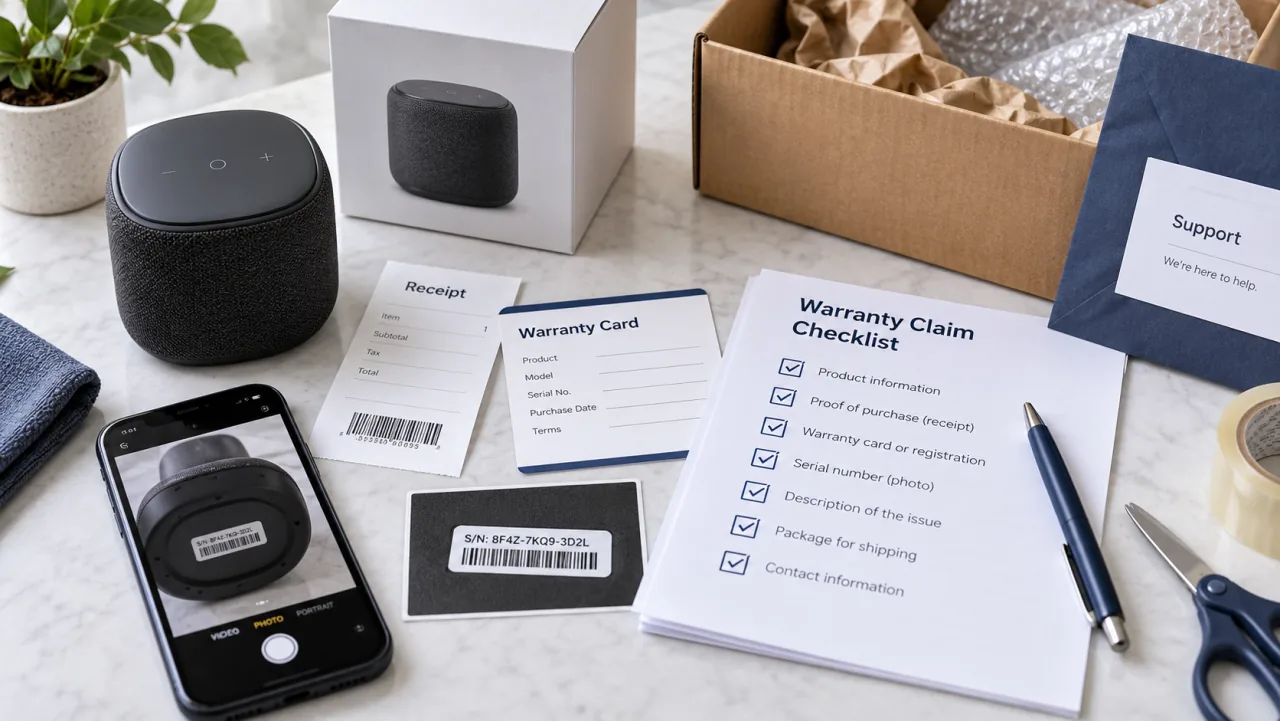
This guide covers manufacturer warranties on consumer products: electronics, appliances, and tools. It doesn't cover car warranties, home-warranty service contracts, or insurance claims, which work differently. It's general information, not legal advice.
Step by step
1. Confirm the product is still under warranty
Check the warranty length against your purchase date (or delivery or installation date). If you're not sure, work it out with the warranty expiration date guide. Claims are far simpler while coverage is active.
2. Read the applicable warranty terms
Find the warranty card, booklet, or the manufacturer's online terms. Note what's covered, what's excluded, how long parts versus labor are covered, and how the company wants claims submitted. This tells you whether your issue qualifies before you spend time on it.
3. Gather your proof of purchase
You'll usually need to show when you bought the product and that you own it. A receipt is ideal; a digital receipt, order history, or product registration may also work. If the receipt is missing, see what counts as proof of purchase.
4. Find the model and serial number
These are usually on a label on the product itself, inside a battery compartment, on the base, or on the original box. Manufacturers use them to confirm coverage and identify the exact unit.
5. Document the defect
Write down what's wrong, when it started, and what you were doing when it happened. Take clear photos or a short video showing the problem. Good evidence speeds up the decision and cuts down on back-and-forth.
6. Contact the manufacturer or retailer
The FTC's guidance is to contact the seller first. If that doesn't resolve it, write to the manufacturer; the warranty lists the address. If a salesperson promised something verbally, get that promise in writing.
7. Submit the claim and put it in writing
Follow the manufacturer's process, whether that's an online form, a support portal, or mail. Even if there's a phone line, the FTC suggests putting your repair request in writing. If you mail a letter, sending it by certified mail with a return receipt gives you proof the company received it.
8. Save the claim or reference number
When you open a claim you'll usually get a case or reference number. Record it, along with names, dates, and what was agreed. You'll need it for every follow-up.
9. Follow up and keep records
Keep a log of all correspondence and calls. If a repair or replacement is promised, note the expected timeline and check back if it slips.
10. Escalate appropriately if needed
If a claim is denied unfairly or stalls, ask for a supervisor, then go up to the manufacturer. If it's still unresolved, you can report the company to the FTC, your state attorney general, a local consumer-protection office, or the Better Business Bureau.
Your warranty-claim packet
Have these ready in one place before you contact support. It's the difference between a 10-minute claim and a week of digging.
- Receipt or other proof of purchase
- Purchase date (or the delivery or installation date, if that's when coverage started)
- Model number
- Serial number
- Warranty information: length and key terms
- Photos or video of the defect
- A clear description of the issue: what's wrong and when it started
- Any prior correspondence with the seller or manufacturer
- The claim or reference number, once you have one
Tips for a smoother claim
- Keep your records from day one. Reconstructing proof after something breaks is the hardest part. A scan of the receipt and the serial number saves it.
- Use authorized service. Unauthorized repairs or modifications can void coverage under many warranties, so check the terms first.
- Be factual and specific. Describe the defect plainly rather than guessing at the cause.
- Don't wait. File while the product is comfortably inside its coverage window.
Keep the documents you'll need for a claim together before something breaks. Slipcrate stores the receipt, purchase date, model, and warranty with each product, so your claim packet is already assembled when you need it.
FAQs
What do I need for a warranty claim? Proof of purchase, the model and serial number, the warranty terms, and evidence of the defect (photos or video) plus a clear description. See the claim-packet list above.
How long does a warranty claim take? It varies widely by company and type of fix, from a few days to several weeks. Your reference number and written records help you follow up if it runs long.
Can I make a warranty claim without the receipt? Sometimes. A digital receipt, order history, or product registration may be accepted, depending on the terms. See warranty without a receipt.
What if my warranty claim is denied? Ask why in writing, escalate to a supervisor and then the manufacturer, and if it's still unfair, report it to the FTC or your state attorney general.
The best time to get ready for a claim is before you need one. A receipt organizer keeps proof of purchase attached to each product, and a warranty tracker keeps the coverage dates with it.
Keep reading
Warranty without a receipt
Lost the receipt? What else can count as proof of purchase for a claim.
How to find your warranty expiration date
Check whether the product is still under warranty before you start a claim.
Receipt organizer app
Keep the receipt, serial number, and warranty together so a claim packet is ready in advance.