
Guide
Can You Claim a Warranty Without a Receipt? What Counts as Proof of Purchase
Sometimes you can. It depends on the warranty terms, and a digital receipt, order history, or other records may count. This guide covers what usually works as proof of purchase.
On this page
Sometimes, yes. It depends on the manufacturer's or retailer's warranty terms. A digital or email receipt, your online order history, a reprinted receipt, or another purchase record may be accepted in place of the original. Requirements vary from company to company, though, so nothing is guaranteed. This guide covers what a receipt actually proves, what can stand in for it, and what to do if yours is gone.
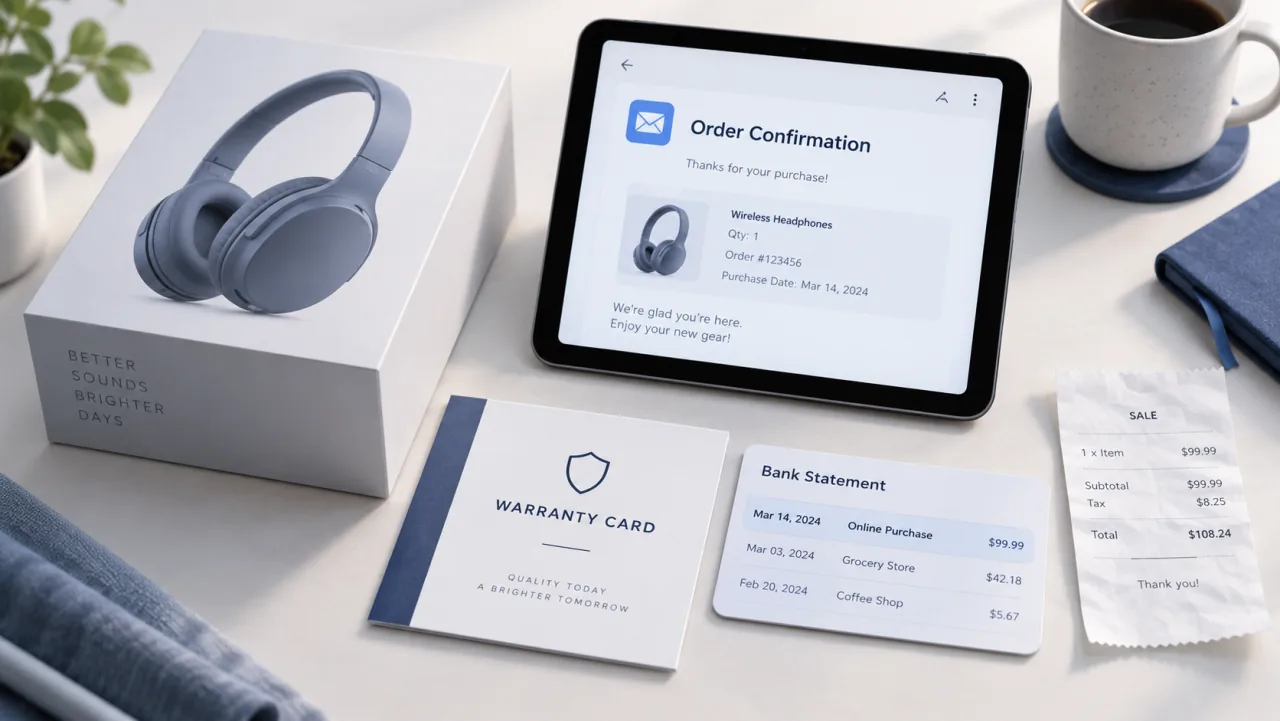
This is general information about consumer warranties in the United States, not legal advice. Your rights depend on the specific warranty terms and your state's laws. Always read the written warranty that came with your product.
Is a receipt always required?
Not always. A receipt does one job for a warranty claim: it shows when you bought the product and that you own it. The U.S. Federal Trade Commission advises consumers to save the product receipt with the warranty precisely because it "proves the date you bought the product and that you're the original product owner."
If you can prove those two things another way, some warrantors will accept it. Others are stricter and want the receipt itself. The only way to know is to read the warranty terms and ask.
Why requirements differ
Two different things often get called "the warranty," and they follow different rules:
- The retailer's return or exchange policy. Set by the store, usually time-limited, and the most likely to insist on the original receipt.
- The manufacturer's warranty. Set by the brand, usually longer, and focused on defects. Alternative proof is more often accepted here.
In the United States, written warranties on consumer products are governed by the federal Magnuson–Moss Warranty Act and the FTC's rules, alongside state law. Two points from the FTC's interpretations are worth knowing:
- A registration card usually isn't a condition of coverage. Under the FTC's guidance, requiring you to return a warranty registration card as a condition of a full warranty is treated as an unreasonable duty that isn't allowed. A limited warranty may ask for it, so read your terms. Losing or never mailing a registration card generally doesn't forfeit your rights under a full warranty.
- Proof-of-purchase rules can depend on the warranty type. For some full warranties, a warrantor may not be able to reasonably demand documentary proof of purchase, and may instead ask you to confirm you're the first owner. Limited warranties more commonly require proof of purchase.
In practice, a receipt is the safest proof, but it isn't always the only acceptable one. Don't assume a claim is hopeless just because the paper slip is gone.
What can you use instead of the original receipt?
Depending on the retailer or manufacturer, these may be accepted. None is guaranteed. They're listed strongest first.
| Proof | How useful | Notes |
|---|---|---|
| Original paper receipt | Strongest | Shows store, date, item, and price. Scan it before it fades. |
| Digital or email receipt | Often accepted | A PDF or emailed receipt usually carries the same details as the paper one. |
| Reprinted / duplicate receipt | Often accepted | Many retailers can reprint a receipt if you paid by card or were signed into an account. |
| Online order history | Often accepted | An order confirmation or account history page shows the item and date. |
| Product registration record | Sometimes | If you registered the product, the brand may already have your purchase on file. |
| Serial / model number | Sometimes | Some manufacturers can estimate coverage from the serial or manufacture date. |
| Bank or card statement | Supporting only | Proves a payment on a date, but not which item. Best used alongside other proof. |
Because a card statement doesn't show what you bought, it rarely stands alone. Paired with a model number or an order record, though, it can help establish the date.
What to do if you've lost the receipt
Work through these in order before you contact support:
- Search your email for an order confirmation or digital receipt. Try the store name, the product, or the word "receipt."
- Check the retailer's order history in your online account or app. Big-box and online stores keep past purchases there.
- Ask the retailer to reprint it. If you paid by card or were logged in, many stores can look the purchase up.
- Find the serial and model number on the product or its box, and register the product with the manufacturer if you haven't.
- Pull the card or bank statement for that date as supporting evidence.
- Read the warranty terms to see exactly what proof is requested and how to submit a claim.
- Contact support and explain what you have. Be ready to confirm you're the original owner.
The easiest warranty claim is the one where the receipt, purchase date, and warranty record are already together. Slipcrate keeps the receipt attached to the product and tracks the coverage, so you're not reconstructing proof after something breaks.
A quick checklist before you contact support
- The product's model and serial number
- Any proof of purchase you could find (receipt, email, order history, statement)
- The purchase date, or your best evidence of it
- The warranty terms and how long coverage lasts
- A clear description of the problem
Once you have these ready, read how to file a warranty claim next.
FAQs
Do you need a receipt for a warranty? Not always. Some manufacturers accept a digital receipt, order history, or product registration instead; others ask for the original receipt. Check the written warranty terms.
Can a bank or credit card statement be used as proof of purchase? It can help, but usually not on its own. A statement shows the date and amount, not which product you bought. Pair it with a model number, order record, or registration.
Can an emailed or digital receipt be used for a warranty claim? Often, yes. A digital receipt generally carries the same purchase details as the paper version, and many companies accept it.
Does losing the registration card void my warranty? Usually not. Under the FTC's warranty rules, returning a registration card generally can't be required as a condition of a full warranty. Registration can make a claim smoother, but it's your terms, not the card, that define your coverage.
The surest fix is to keep proof before you need it. A receipt organizer keeps the receipt attached to each product, and a warranty tracker keeps the purchase date and coverage with it. The next claim then starts with everything already in one place.
Keep reading
Receipt organizer app
Keep every receipt attached to the product it belongs to, so proof of purchase is always a tap away.
How to file a warranty claim
A step-by-step guide to making a consumer-product warranty claim, from gathering documents to following up.
How to find your warranty expiration date
Figure out whether a product is still under warranty, with a quick expiry calculator.